

The Magnetic Janus Revolution: How Small Particles Are Changing Materials Science
At the cutting edge of soft matter and materials science, magnetic Janus particles are redefining what’s possible in medicine, sustainability, and smart manufacturing. With their dual nature and magnetic responsiveness, these tiny structures give us unprecedented control over motion, self-assembly, and material behavior—all at the microscopic scale.
What Are Magnetic Janus Particles?
A magnetic Janus particle is a unique type of colloidal particle with two distinct sides. One side is coated with a magnetic material such as iron oxide, while the other has different chemical or physical properties—like being water-attracting (hydrophilic) or water-repelling (hydrophobic).
This duality allows them to:
Align or reorient in magnetic fields
Interact selectively with different environments such as water, oil, or gels
Self-assemble into programmable, intricate structures
In essence, they operate like microscale machines—adapting to their environment and responding to multiple cues, including magnetic, electric, and thermal signals.
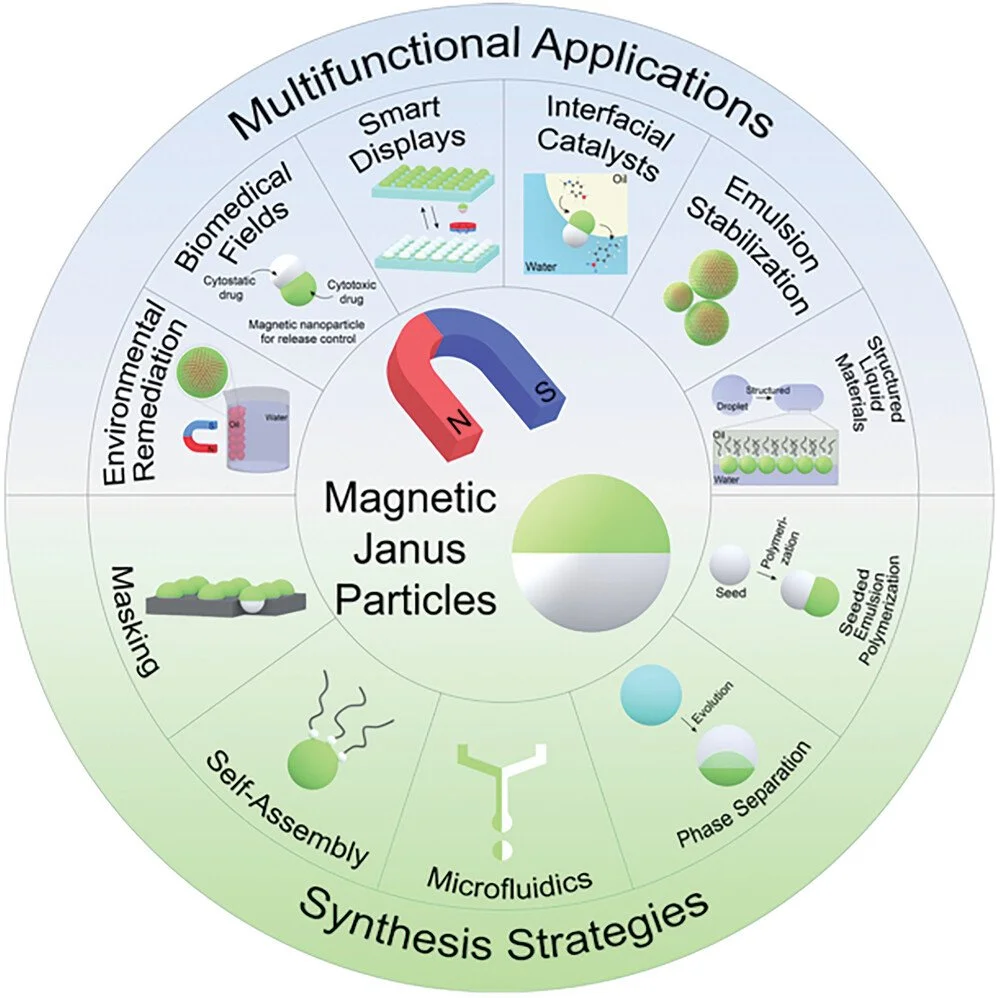
Source: Magnetic Janus Particles: Synthesis and Multifunctional Applications, Wiley Online Library
Our Role in Unlocking Their Potential
Our research group, Theoretical Soft Matter & Fluid Mechanics, at the University of Mayagüez, led by Prof. Ubaldo Córdova-Figueroa, we are working at the forefront of this revolution. Our group combines advanced computational modeling, theory, and machine learning to design and predict the behavior of these particles for real-world applications.
Our research focuses on:
Colloidal Gels – Studying how magnetic Janus particles alter the mechanical and structural properties of gels.
Self-Assembly – Revealing how particles organize under magnetic fields or fluid flows.
External Control – Developing ways to program particle behavior with magnetic and electric stimuli.
Through simulations, we uncover dynamics that experiments alone cannot capture, helping accelerate the development of smarter, more responsive materials.
From Simulations to Smart Systems
Our work has already revealed exciting possibilities:
AI-Driven Material Discovery – Using machine learning, we accelerate the design of particle systems optimized for pollutant removal, drug delivery, or soft robotics, reducing years of trial-and-error research.
Smart Gels for Biomedicine & Beyond – Embedding Janus particles in gels enables magnetically guided drug release for chronic wounds, tumors, or inflammation, while also being applied to environmental cleanup.
Programmable Self-Assembly – By applying external fields, we guide particles into predefined structures, opening doors for 3D printing, nanorobotics, and flexible electronics.
Transformative Applications
Magnetic Janus particles are no longer confined to theory or lab demonstrations. They are already influencing multiple industries:
Biomedicine
Targeted drug delivery using magnetically directed gels
Cancer treatment with hyperthermia from magnetically heated particles
Responsive scaffolds for regenerative medicine
Next-generation MRI contrast agents
Manufacturing & Robotics
Soft robotics with muscle-like adaptive materials
3D printing using magnetically structured gels
Wearable technologies that react to pressure, temperature, or motion
Environmental & Sustainability
Oil spill cleanup using magnetically retrievable particles
Smart filters to remove microplastics and heavy metals
Eco-friendly materials built with self-assembled, biodegradable polymers
The Road Ahead
From responsive gels for wound healing to pollution cleanup systems, magnetic Janus particles are reshaping the future of materials science. They are adaptive, programmable, and transformative—guided by external fields and refined through computational insight.
At the Theoretical Soft Matter & Fluid Mechanics Research Group, we are not merely studying these particles—we are harnessing them to build a smarter, cleaner, and healthier world.