

What is an Amphiphilic Janus Particle?
In the ever-evolving field of materials science, few innovations capture the imagination quite like amphiphilic Janus particles. These tiny, dual-faced structures—named after the Roman god Janus, who looked both forward and backward—are reshaping how we think about smart and sustainable materials.
At the Theoretical Soft Matter & Fluid Mechanics Research Group, led by Prof. Ubaldo Córdova-Figueroa at the University of Mayagüez, we are at the forefront of exploring these particles through advanced computational simulations. By doing so, we are pushing the boundaries of what soft matter science can achieve.
What Makes Janus Particles Special?
Janus particles exist at the microscopic or nanoscale, with two chemically distinct surfaces: one hydrophilic (water-attracting) and the other hydrophobic (water-repelling). This dual affinity allows them to behave like surfactants, but with much more precise control over orientation, self-assembly, and responsiveness to external stimuli like magnetic fields.
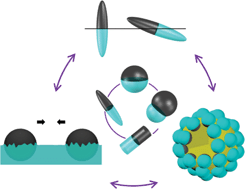
Source: Amphiphilic Janus particles at fluid interfaces, Soft Matter Journal
Unlike conventional surfactants, Janus particles can:
Self-assemble into complex structures
Be magnetically or chemically guided
Function under harsh or tunable conditions
Serve as building blocks for responsive, smart, and sustainable materials
They are part of the broader class of soft matter—materials such as gels, foams, and colloids that are easily deformed and highly responsive to their environment.
Real-World Applications
Our research—and that of others worldwide—shows that amphiphilic Janus particles have remarkable potential across multiple industries:
Targeted Medical Delivery – Smart gels designed with Janus particles can transport drugs precisely where needed in the body, creating new opportunities for treating cancer and chronic diseases.
Environmental Remediation – Their amphiphilic surfaces allow them to capture oil, microplastics, and harmful chemicals from water efficiently.
Water Purification & Chemical Detection – Engineered Janus particles can detect and eliminate pollutants in real-time, offering safer drinking water and cleaner wastewater systems.
Responsive Materials & Gels – By incorporating magnetic properties, these particles enable gels to change shape, stiffness, or flow in response to external fields—useful in robotics, adaptive biomedical devices, and actuators.
Sustainable Manufacturing – Their ability to regulate self-assembly can reduce energy use and material waste in nano- and micro-scale fabrication.
Our Contributions
At our group, we are using detailed computational models to uncover the physics of amphiphilic Janus particles and design the next generation of functional materials. Some of our recent achievements include:
Smart Colloidal Gels – We simulate how magnetic and amphiphilic Janus particles behave in gels, guiding the design of materials for filtering contaminants or delivering medication.
Self-Assembly Under Shear Flow – We discovered how these particles arrange themselves in flowing liquids, critical for applications like 3D printing, biomimetic materials, and scaffolds for tissue engineering.
Rheology of Complex Fluids – By studying how Janus particles influence flow properties, we can design fluids with programmable viscosities—ideal for injectables, coatings, and smart lubricants.
Tailored Interactions for Material Design – Through careful tuning of surface chemistry, we’ve demonstrated precise control over self-assembly, paving the way for materials with specific mechanical, thermal, and chemical features.
Looking Forward
Amphiphilic Janus particles may be microscopic, but their impact is anything but small. From curing diseases to cleaning oceans and advancing sustainable manufacturing, these tiny marvels are helping shape the future of smart and adaptive materials.
At the University of Mayagüez, we are proud to contribute to this exciting field, combining theory, computation, and application to transform potential into reality.
If you are a student passionate about physics, chemistry, or engineering—and you’re excited about solving real-world challenges with cutting-edge simulations and material design—we invite you to join us. At the Theoretical Soft Matter & Fluid Mechanics Research Group, you’ll have the opportunity to work on collaborative projects pushing the boundaries of soft matter science.