

The Future with Janus Particles: Unlocking New Potential in Materials Science
In the world of innovative materials science, few innovations are as promising as Janus particles. With the ability to revolutionize industries from medicine to energy, these unique particles are poised to change how we think about everything from drug delivery to pollution control. Leading the charge in this exciting field is the Theoretical Soft Matter & Fluid Mechanics team at the University of Puerto Rico in Mayagüez, whose research is already yielding groundbreaking results.
Janus particles are nanoparticles with two distinct faces, each showing different physical or chemical properties. These particles are named after Janus, the Roman god with two faces, symbolizing their dual characteristics. By combining materials with opposing traits on each side of the particle, Janus particles can interact with their environment in unique and versatile ways. Some characteristics include their biphasic nature (each particle has two sides with different properties), their size— ranging from nanometers to micrometers— that make them ideal for nanoscale applications, and their specialized interactions with the unique properties allow them to perform tasks that traditional particles cannot.
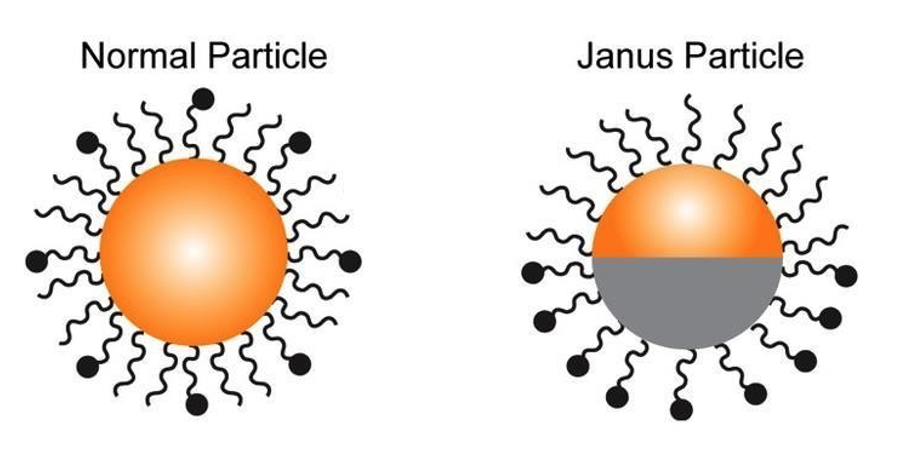
From Indiana University at eurekalert.org
The potential applications for Janus particles span many fields, and their impact could be transformative across industries:
1. Medical Applications:
o Targeted Drug Delivery: Janus particles can transport drugs directly to the area of need in the body, that way enhancing treatment effectiveness while minimizing side effects.
o Advanced Diagnostics: Their unique properties make them ideal candidates for developing better diagnostic tools, improving accuracy in medical testing.
2. Energy and Environmental Solutions:
o Efficient Catalysis: In energy production, Janus particles could be used to create more efficient chemical reactions, particularly in solar cells and fuel cells.
o Pollution Control: Their ability to interact with pollutants makes them useful for removing toxins from water or cleaning up oil spills.
3. Material Science:
o Smart Coatings: Janus particles can be used to develop coatings that are both self-healing and resistant to wear, water, or even extreme temperatures. o New Structural Materials: The unique behavior of these particles could lead to the creation of materials that are stronger, lighter, and more flexible
Our research group has been deeply engaged in studying Janus particles, despite initial challenges. With most of our team coming from mechanical engineering backgrounds, there was a steep learning curve—we had to become familiar with the physics of nanomaterials, a scale far smaller than what we were accustomed to.
As we immersed ourselves in the world of nanoscience, our work began to take shape. We gradually mastered the complex physics behind Janus particles, and through a combination of detailed simulations, laboratory experiments, and collaborations with other researchers, our team has made significant progress.
Some of our key discoveries include:
Nanoparticle Catalysts: Janus particles have shown significant promise in chemical manufacturing, where they can increase reaction efficiency and reduce energy costs.
Self-Assembling Materials: The team has also developed new materials that can self-assemble into complex structures, opening possibilities for innovative technologies in electronics and manufacturing.
Targeted Drug Delivery: Initial experiments show that Janus particles could vastly improve the precision and efficacy of drug delivery systems, particularly in the fight against diseases like cancer.

(1) Soft Matter Journal via pubs.rsc.org (2) Measuring, Modeling, and Predicting the Magnetic Assembly Rate of 2D-Staggered Janus Particle Chains Article at par.nsf.gov
The ability to manipulate Janus particles offers enormous benefits for industrial production and environmental sustainability. Additionally, they could enhanced manufacturing efficiency, the improvement of materials and environmental cleanup
The future of cleaner energy, smarter materials, and healthier environments looks promising, thanks to the versatility of these remarkable particles
Our work on Janus particles is just getting started, and there is still much to discover. As we continue our research, we are looking for partners, collaborators, and donors who are interested in supporting these transformative technologies.
Ways You Can Get Involved:
Collaborate: If you are a researcher, scientist, or company looking to integrate Janus particle technology, the team welcomes collaboration.
Donate: Support the next generation of materials science and nanotechnology by donating to the team’s ongoing research.
Advocate: Help raise awareness about this exciting technology and its potential to change the world.
To learn more about the our research group and how you can contribute, visit our official website.
The future with Janus particles holds endless possibilities. From creating more efficient energy systems to advancing medical treatments and creating sustainable materials, these tiny particles are poised to change the way we think about innovation. Our team is at the forefront of this groundbreaking research, and with continued support and collaboration, we will continue to uncover the full potential of Janus particles.