

Student Spotlight: Wilmer A. Martinez-Valle
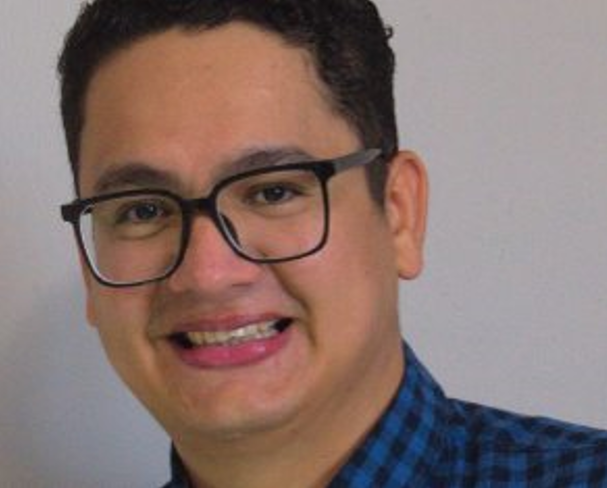
Wilmer A. Martinez-Valle
Ph.D. Candidate, Mechanical Engineering
From Bucaramanga, Colombia to the Theoretical Soft Matter & Fluid Mechanics Research Group at the University of Puerto Rico at Mayagüez (UPRM), Wilmer A. Martinez-Valle is exploring the microscopic world of self-propelling particles through physics, chemistry, and computation. Now in his fifth year of the Ph.D. program in Mechanical Engineering, Wilmer conducts research under the mentorship of Dr. Ubaldo M. Cordova Figueroa, where he studies the behaviors and self-assembly of active-magnetic particles—a subject that fuses curiosity-driven science with real-world potential.
Unlocking the Potential of Active-Magnetic Particles
Wilmer’s work centers on understanding how nanoscale particles—specifically, active particles with magnetic interactions—behave under controlled conditions such as dipolar shift, dipolar strength, and self-propulsion. “My research focuses on understanding how nano-particles that move on their own, called ‘active particles,’ and combine with magnetic interactions behave under several customized parameters...” he explains. These particles can “swim” independently due to chemical reactions on their surfaces, a mechanism that opens the door to innovations in medicine, diagnostics, and environmental applications.
To explore these systems, Wilmer runs Brownian dynamics simulations to model how the particles self-organize over time and what emergent structures arise. “I also analyze the data, interpret the results, and help connect what we observe in the simulations to physical mechanisms and potential applications.”
This work doesn’t just live in theory. It has the potential to revolutionize biomedical and environmental technologies. “These active particles could be used in drug delivery systems, where they navigate through the body to target specific areas. They also have potential in microfluidic devices for diagnostics and even in environmental cleanup, like removing pollutants in water.”
A Passion for Discovery and Impact
Wilmer’s fascination with soft matter and autonomous microscopic behavior is what drew him into this field. “The idea of using physics and chemistry to control microscopic behavior really captured my attention, especially because it connects fundamental science with real-world applications like medicine and the development of new materials.” That balance—between deep scientific curiosity and the possibility for meaningful application—continues to drive his work.
His research has already led to promising findings: “Preliminary results on active-magnetic Janus particles have established a framework for developing new materials... demonstrating novel kinetic behaviors and the formation of distinctive structures, which are highly sensitive to controllable parameters.”
Where Curiosity Meets Impact
For Wilmer, research is more than solving equations or running simulations—it’s about uncovering how the world works at its most fundamental level, and then using that knowledge to make a difference.
“This research is important to me because it combines curiosity-driven science with the potential for real-world impact,” he shares. What motivates him isn’t just the end application—it’s the beauty of complexity emerging from simplicity. “I’ve always been fascinated by how simple rules can lead to complex, dynamic behavior, such as how tiny particles can move independently and interact with their surroundings.”
His work with active-magnetic colloids allows him to bring that fascination into action every day, blending theory with technology. “Working on active-magnetic colloids allows me to explore those ideas using physics, coding, and problem-solving.”
It’s a powerful intersection of creativity, scientific rigor, and the hope that today’s simulations could become tomorrow’s breakthroughs.
Growing Through Research
Through this research experience, Wilmer has built a toolkit of technical and personal skills: “Technically, I’ve gained skills in simulation tools, programming, and scientific analysis. Personally, I’ve learned how to be persistent, think critically, and communicate complex ideas in simpler terms...” This growth has also shaped his career goals. “This experience has made me seriously consider a future in research, potentially pursuing an academic career.”
He is currently preparing his first manuscript for submission to Soft Matter and looks forward to sharing his findings more broadly in the near future.
Powered by Collaboration
Collaboration has been essential to Wilmer’s success. “I collaborate closely with a faculty advisor and other students... discussing ideas, debugging code, and interpreting results together has made the research stronger and more rewarding.” He also credits UPRM’s high-performance computing resources, as well as faculty mentorship and access to academic journals as critical supports throughout his journey.
Looking Ahead
Wilmer’s next steps include collaborating on a project focused on fabricating active-magnetic Janus particles using both theoretical and experimental methods. The goal: to prepare and submit a manuscript that bridges simulation and laboratory insight.
In the long term, he hopes his work will lead to practical technologies that improve health, diagnostics, and environmental sustainability. “I hope it contributes to designing controllable micro-systems that can improve human health, make lab testing more efficient, or help address environmental problems.”
Words of Advice
Reflecting on his research journey, Wilmer shares:
“Seeing that my simulations actually work and match physical theories has been incredibly rewarding. Also, being able to explain what I’m doing to others and seeing them get curious is a great feeling.”
For other students thinking of getting involved in research, his message is simple:
“Start by asking questions—curiosity is key. Don’t be afraid to reach out to professors or join a project, even if you’re still learning. You’ll grow through the process...”
Wilmer’s story is a powerful reminder that the smallest scales of matter often offer the biggest opportunities to create change.
With donor support, students like him can continue transforming bold ideas into solutions that shape a better future. Join us in fueling the next generation of scientific breakthroughs.