

A New Era of Energy: Gallium Ferrite Batteries Promise Cleaner, More Powerful Future
The race for better battery technology just took a leap forward. Members from our research group have introduced a groundbreaking energy storage innovation: batteries made with Gallium Ferrite (GaFeO₃).
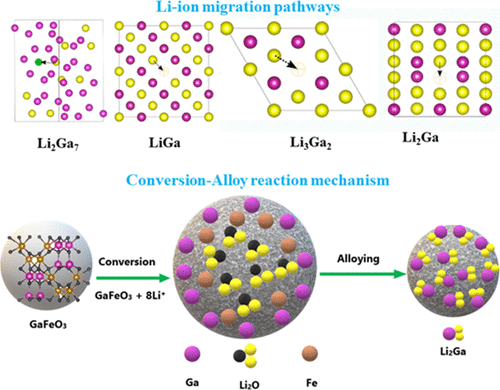
From the article: Unveiling Potential of Gallium Ferrite (GaFeO3) as an Anode Material for Lithium-Ion Batteries at pubs.acs.org
This new material could reshape the way we power electric vehicles, store renewable energy, and reduce the environmental footprint of the tech we use every day.
Gallium Ferrite is a multiferroic compound, meaning it shows multiple ferric properties and more specifically, ferroelectricity and ferromagnetism within the same material. It is made by combining gallium, a soft metal used in semiconductors, with iron oxides.
What makes Gallium Ferrite special is its stability, non-toxicity, and unique ability to respond to electric and magnetic fields. These traits make it an ideal candidate for advanced batteries and energy systems.
Unlike traditional lithium-ion batteries that rely on limited and environmentally damaging materials like cobalt, Gallium Ferrite offers a more sustainable and high-performance alternative. Including an actual performance metric:
Initial discharge capacity ~887 mA·h/g
Stable capacity ~200 mA·h/g over 450 cycles
Coulombic efficiency ~99.6% at 100 mA·g⁻¹
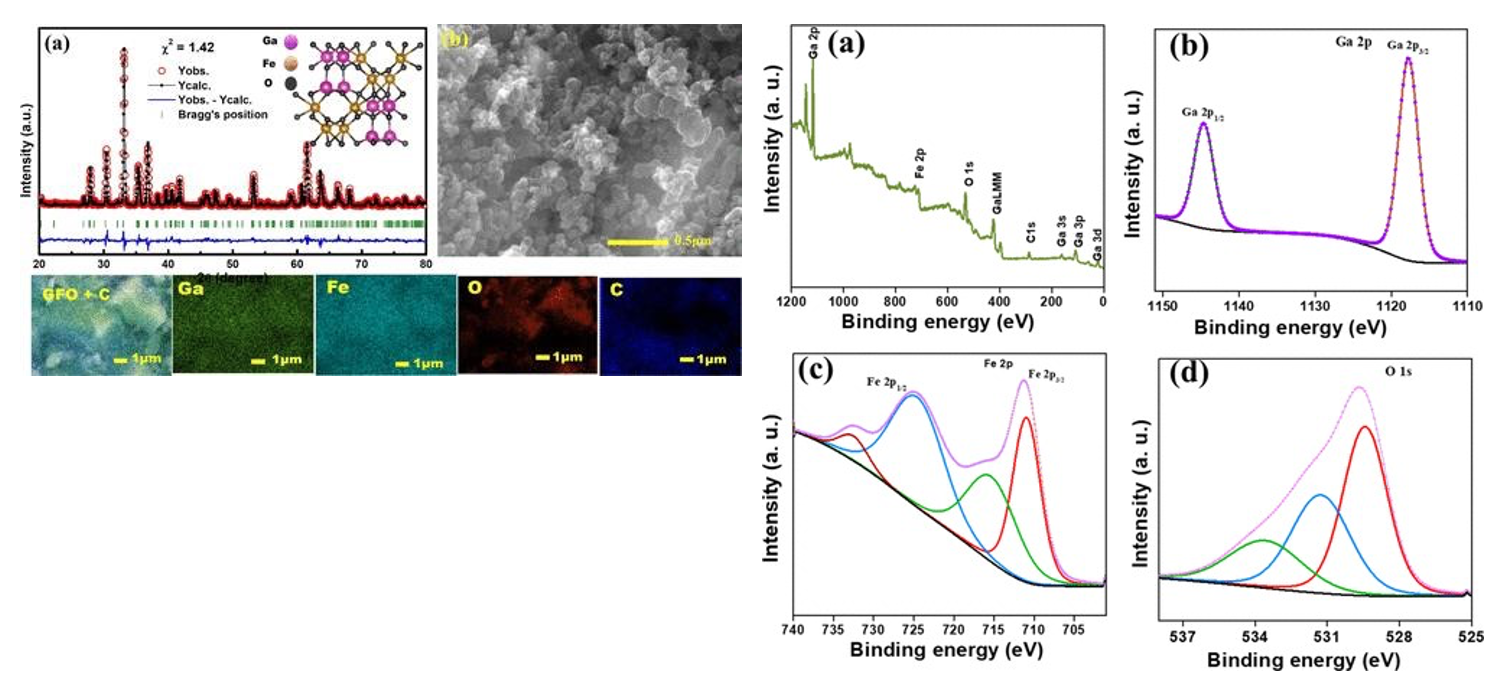
From the article: Unveiling Potential of Gallium Ferrite (GaFeO3) as an Anode Material for Lithium-Ion Batteries at pubs.acs.org
Our team has spent the past two years synthesizing high-purity Gallium Ferrite crystals and testing them in prototype battery cells. Using advanced spectroscopy, impedance analysis, and electron microscopy, they tracked how ions move and how the material behaves under stress.
One surprising aspect of our team? Most of our members are mechanical engineers. While this background brings strong systems and materials analysis skills, it also highlights a current limitation: we need more chemical engineers—specifically those with ability in electrochemistry and battery materials—to fully unlock Gallium Ferrite’s potential.
If scaled up, Gallium Ferrite batteries could dramatically change several sectors like electric vehicles, making them lighter, safer and longer lasting batteries. A better grid storage support for renewable energy. Lastly, but not least making consumer electronics have longer battery life, and faster charging.
Environmentally, this technology avoids many of the ethical and ecological concerns tied to lithium and cobalt extraction. It also offers better recyclability, helping build a cleaner supply chain for the future.
The Gallium Ferrite battery is still in development—but its promise is real. The next steps involve scaling up synthesis, chemistry-driven optimization, large-scale testing, building a more interdisciplinary research team and—most importantly—securing more funding.
Want to help drive change?
• 🔗 Visit the team’s website: ucfcolloids.org
• 🧪 Collaborate: Researchers and engineers are welcome
• 💬 Share this story to raise awareness
• 💰 Donate or invest in sustainable energy research
• 🗣️ Advocate for public support and clean energy funding
Gallium Ferrite batteries stand for more than just scientific progress—they offer a pathway toward a cleaner, safer, and more energy-efficient future.
With strong research foundations and a dedicated team, this breakthrough has already proven it can outperform conventional batteries. But to reach its full potential, it needs more minds, more support, and more momentum.