

Student Spotlight: Sebastián Suárez Machaca

Sebastián Suárez Machaca
M.S. Candidate, Mechanical Engineering
The next generation of technological innovation—from biomedical devices to space exploration—depends on materials that can respond, adapt, and perform in ways that today’s static materials simply can’t. Behind these breakthroughs are emerging scientists whose creativity and technical skill shape how we design the materials of tomorrow. At the University of Puerto Rico at Mayagüez (UPRM), first-year Mechanical Engineering master’s student Sebastián Suárez is one of those scientists.
Supported by UPRM’s research infrastructure and the mentorship of Dr. Ubaldo Córdova Figueroa, Sebastian is exploring how microscopic particle interactions can be harnessed to design the 3D-printing materials of the future. His work in the Theoretical Soft Matter & Fluid Mechanics research group blends computation, fluid mechanics, and advanced materials—an intersection where some of the most exciting developments in soft matter science are unfolding.
Research Focus
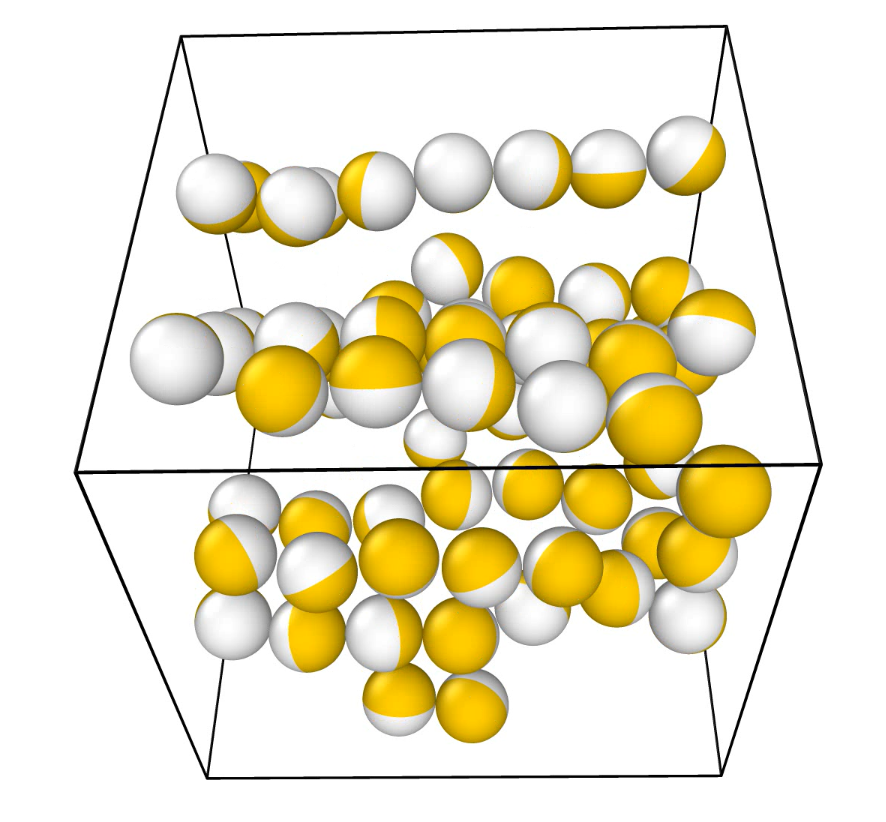
Sebastian’s research explores how to create entirely new classes of 3D-printing materials by combining polymers with specialized particles known as Metallodielectric Janus particles. These particles are “two-faced”: one side has a dielectric surface while the other carries a thin metallic conductive coating. When exposed to an external electric field, this asymmetry allows them to self-assemble into rich, tunable structures that can significantly alter a material’s behavior.
By blending these particles into 3D-printing resins, Sebastian studies how their unique structure influences—and potentially enhances—the mechanical and functional properties of printed materials. As he explains, “In simple terms, I am trying to figure out how to design 3D printing ‘inks’ whose properties can be tuned or programmed by controlling what we put inside them and how those ingredients arrange themselves at very small scales.”
His interest in this area grew out of the rapid experimental progress in soft materials and the expanding possibilities of 3D printing. The idea that material properties can be programmed—that strength, flexibility, or responsiveness can be built directly into the microstructure—captivated him early on. The ability to design materials from the ground up for specific applications, rather than simply using what already exists, is a central motivation behind his work.
Sebastian’s contribution to this field lies in developing the computational tools that reveal how these complex mixtures behave. He designs and runs microscopic-scale simulations using Brownian dynamics to model interactions between polymers and Janus particles. This work requires writing and optimizing GPU-accelerated code, validating the model against previous studies, and conducting detailed literature reviews to connect simulation outcomes with experimental and theoretical insights. He also determines which parameters and conditions to explore so that the simulations can meaningfully guide experiments and help shape future material design strategies.
Why this Research Matters
By developing 3D printing materials with programmable mechanical properties—such as tunable stiffness, enhanced toughness, or tailored flexibility—this research opens the door to manufacturing components that behave in highly specific and predictable ways. Imagine flexible parts that still maintain structural integrity, or printed materials that respond differently depending on the environment they’re placed in. These kinds of capabilities would significantly broaden what engineers and designers can achieve with additive manufacturing. Looking further ahead, materials that can be tuned or assembled at the microscopic level could become especially valuable in space-related technologies.
On a scientific level, this work deepens our understanding of how complex soft materials acquire their macroscopic behavior from interactions at micro- and nanoscales. This is a central challenge in fields like mechanical engineering and materials science, where there is a growing push to move away from trial-and-error approaches toward more rational, predictive material design. By uncovering how Janus particles and polymers organize and interact, this research helps build a foundation for designing materials with intention rather than intuition.
From a broader industrial and societal perspective, these insights can accelerate innovation across multiple sectors. Better-designed 3D printing materials can enable next-generation biomedical devices, more adaptable robotic components, advanced aerospace structures, and new tools for space exploration. Furthermore, the computational models developed through this research can help engineers evaluate material behavior without relying on costly or time-consuming experiments, making the design process more efficient and accessible.
Building the Computational Foundation
Sebastian’s primary role is theoretical and computational. He develops the simulation models used to understand how polymers and Janus particles behave.
“I design and run simulations that describe how mixtures of polymers and Janus particles behave at the microscopic level, primarily using Brownian dynamics.”
He writes and optimizes GPU-accelerated code, validates new models against existing studies, and explores parameter spaces to guide experimentalists toward promising material regimes. A major breakthrough so far has been:
“The development of a model to efficiently simulate metallodielectric Janus particles at a fraction of the computational cost of previous approaches.”
By accelerating computations using CUDA and GPUs, Sebastian enables simulations that were previously too large, too slow, or too expensive to run—dramatically expanding what his team can study.
Growing as a Researcher
Through his work, Sebastian Suarez has developed both technical expertise and a deeper understanding of the scientific process. Technically, he has learned to program and optimize code using CUDA to fully leverage GPUs, a skill that is highly valuable in modern computational science and engineering. He has also gained hands-on experience implementing Brownian dynamics simulations, learning how to make them stable, efficient, and relevant to real physical systems.
On a personal level, Sebastian has strengthened his ability to read scientific literature critically and efficiently, enabling him to identify the most relevant information for advancing his work. He has also deepened his understanding of how material properties emerge—not only from atomic interactions, but also from how different components are arranged and interact at the microscopic scale.
This research has further solidified his interest in computational modeling, soft matter, and fluid mechanics. For instance, his study of Stokes flow has expanded his perspective on how fluids and particles behave across different length scales, from the continuum level down to the micro- and nanoscale. These experiences are helping him clarify his future path, whether that leads to a Ph.D. focused on computational materials and complex fluids or to a career in industry where advanced simulations and material design are central.
A Collaborative Ecosystem
Sebastian is part of a collaborative research environment that brings together computational and experimental expertise. He is currently involved in the NASA MOSAICS project, which includes an experimental component led by Professor Carlos Martinez at Purdue University. “This collaboration between computational and experimental teams has been very valuable. It helps us identify gaps in knowledge, align our simulations with realistic experimental conditions, and refine the goals of the project so that the computational work can meaningfully support and complement the experiments.” he says.
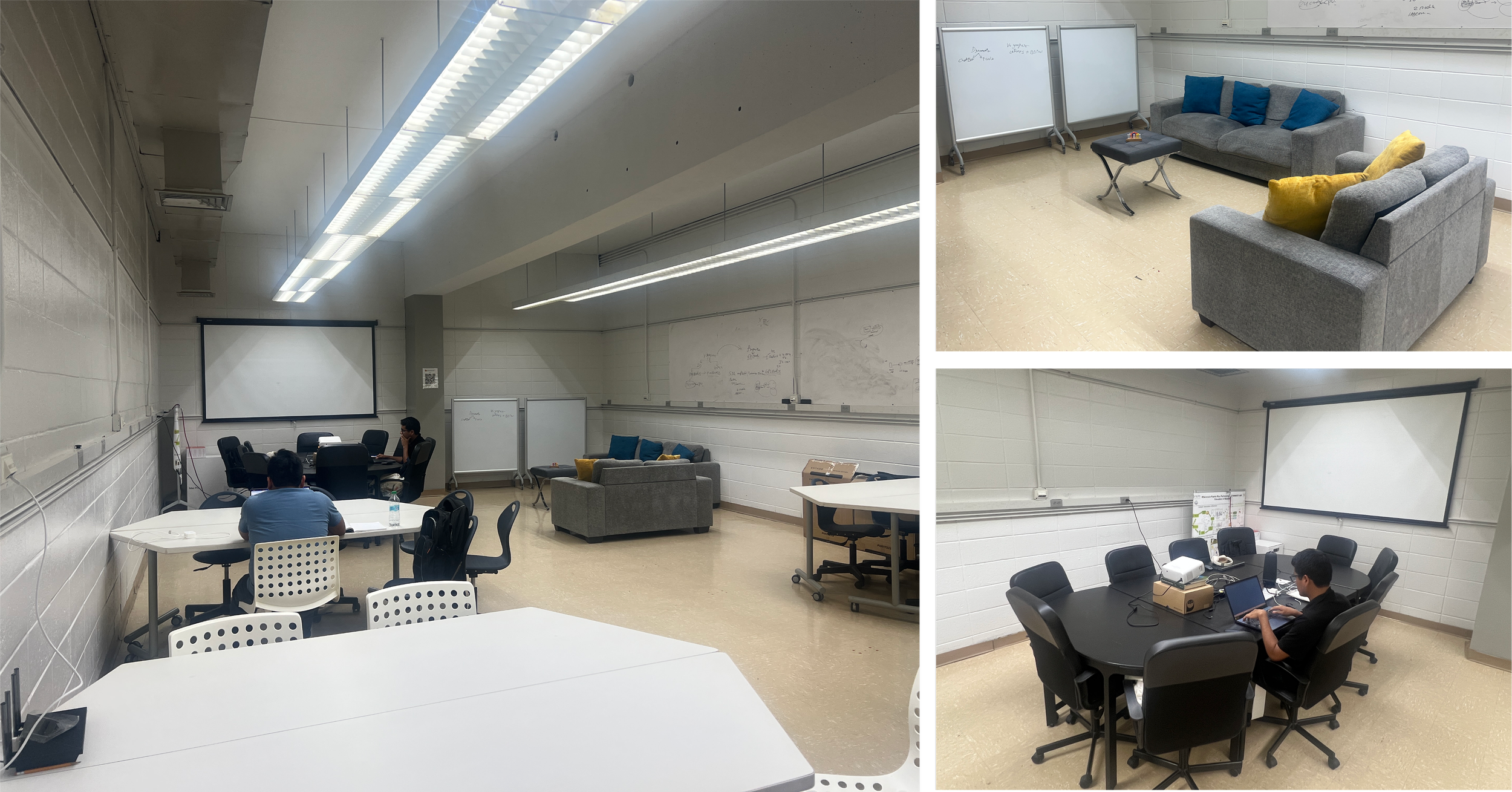
The office and computational space in F-217 has also been essential to his work. “Having a dedicated space and the proper hardware makes a big difference in being able to work efficiently and stay focused on research.” Sebastian explains, providing a focused environment for coding, running simulations, analyzing data, and keeping up with the literature. Together, these elements create a supportive ecosystem that enables his research to advance efficiently and effectively.
Looking Ahead
The immediate focus of Sebastian Suarez’s project is to complete the development of his simulation code and thoroughly validate it against results from previous studies and established theoretical predictions. Once validated, the code will be used to systematically explore how different parameters—such as particle concentration, particle type, and polymer blend composition—affect the structure and properties of the material. This exploration will help identify the most promising conditions for future experiments and potential applications.
In the long term, Sebastian hopes his research will contribute to the creation of new classes of 3D printing materials and a deeper understanding of how complex soft materials behave at small scales. “Ideally, the models and insights from this work will help other researchers and engineers design materials in a more predictive way, reducing trial and error,” he says. He also envisions his work supporting technological advances in challenging environments, such as space, where the ability to manufacture tailored materials on demand could be transformative.
Words of Advice
For Sebastian Suarez, one of the most rewarding aspects of research has been “the feeling of actively participating in scientific progress in real time.” He finds motivation in knowing that the models he designs and the simulations he runs can uncover new insights into how materials behave. He also enjoys the ongoing process of learning—whether it’s mastering a new numerical method, understanding a subtle physical concept, or discovering the connections between different areas of science and engineering.
His advice to other students embarking on research is to approach it as both a technical and personal learning experience.
“Try to absorb as much as you can about the topic itself, but also pay attention to the skills you are building—problem-solving, persistence, communication, and critical thinking,” he says.
Research can be challenging, but Sebastian emphasizes that if students remain curious and open to learning, it can become one of the most enriching parts of their academic journey.