

Soft Robotic Advances with Soft Matter
Soft robotics is changing how we think about machines by blending biology and engineering in exciting new ways. Unlike traditional rigid robots, soft robots are built from materials that are flexible, adaptable, and able to respond to their environments much like living organisms. At the core of these advances is soft matter—a fascinating class of materials with complex physical behaviors, including polymers, gels, and colloids.
At the University of Puerto Rico in Mayagüez (UPRM), our Theoretical Soft Matter & Fluid Mechanics research team is exploring how soft matter science can unlock new possibilities in soft robotics. Specifically, we focus on a unique type of material called Janus colloids—tiny particles with two distinct sides, each having different chemical or physical properties.
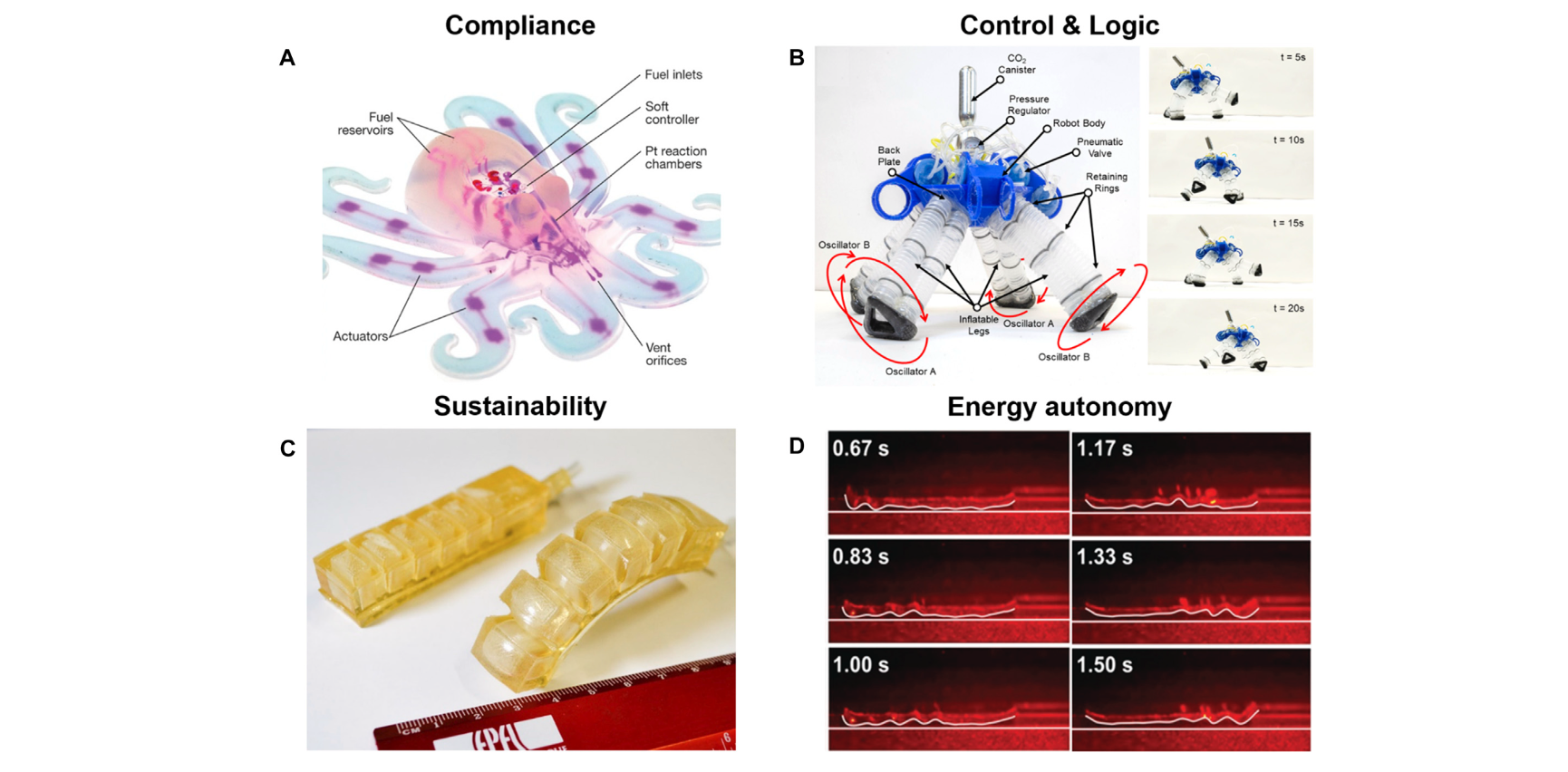
Source: Early career scientists converse on the future of soft robotics article at frontiersin.org
What are Janus colloids and why are they important?
Janus colloids are particles typically a few hundred nanometers to microns in size, with each side engineered to behave differently. For example:
One side may be hydrophilic (water-attracting) while the other is hydrophobic (water-repelling).
One hemisphere can be magnetic, conductive, or responsive to light or temperature stimuli.
This asymmetry allows Janus colloids to self-assemble into complex structures and respond dynamically to external cues. By precisely controlling their interactions and collective behaviors, researchers can design smart materials that mimic biological tissues—capable of movement, adaptation, and self-healing.
How can this connect to soft robotics?
Our research investigates how Janus colloids can be designed and modeled to create components that:
Imitate natural movements like muscle contractions or peristalsis.
Respond dynamically to environmental changes.
Adapt and reconfigure themselves when conditions shift.
These capabilities are especially valuable for delicate, high-precision tasks—such as performing minimally invasive surgeries, delivering medication directly to specific tissues, or assisting tissue regeneration in biomedical engineering.
Why this matters for medicine and beyond
The intersection of soft matter science and soft robotics holds enormous promise across several fields:
Targeted Drug Delivery: Janus colloid-based soft robots can be engineered to navigate biological environments, precisely localizing therapeutic agents at tumors or inflamed sites. This reduces systemic side effects and enhances treatment efficacy.
Tissue Engineering and Regenerative Medicine: Soft robotic scaffolds built from self-assembling Janus colloids can mimic the mechanical and biochemical cues of native tissues, guiding cell growth and regeneration for wound healing or organ fabrication.
Minimally Invasive Surgery: Soft robots constructed with Janus materials can maneuver through narrow or delicate anatomical pathways with high dexterity, enabling safer surgeries with less tissue damage and faster patient recovery.
Early Diagnostics and Smart Imaging: Nanoscale devices incorporating Janus particles could be deployed for sensitive disease detection, providing real-time monitoring and early intervention.
Using computational modeling to innovate
A big part of our approach is using computational simulations to predict how Janus colloids behave and self-organize. This lets us optimize material designs before physical experiments, saving time and resources. It also helps us tailor materials to be highly responsive, efficient, and sustainable.
Importantly, this work bridges physics, chemistry, and materials science—bringing together diverse knowledge to solve complex problems.
Our vision for the future
Our mission is to expand scientific understanding while developing practical, multifunctional materials that solve real-world challenges—from improving cancer treatments to cleaning up environmental hazards.
By combining the power of soft matter with the versatility of soft robotics, we can help create a new generation of robots that are smarter, safer, and more biologically integrated—transforming medicine and technology in ways we’re just beginning to imagine.