

Make the Swimmer Longer and the Swarm Changes: Shape Anisotropy in Active Rods
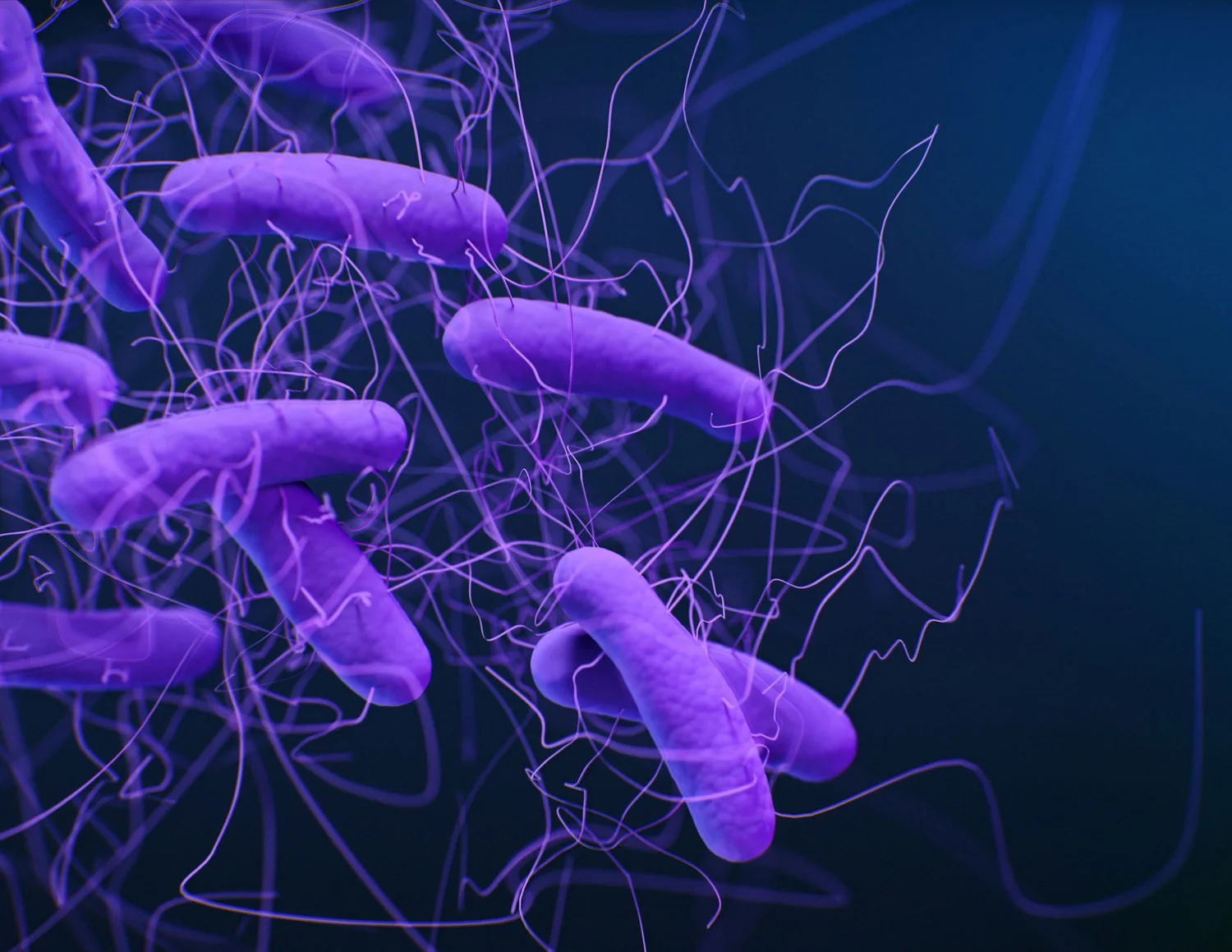
Most synthetic active matter is made of spheres, because spheres are easy to make and easy to simulate. Biology mostly is not. E. coli, Bacillus subtilis and Myxococcus xanthus are rods, and rods align with their neighbors for a reason that has nothing to do with signaling: two elongated objects that collide can only stay close by pointing the same way. Separating that purely geometric effect from the biochemical ones has been hard, because the experiments were being done on the organisms themselves.
A study published in Science in April 2026 by Yogesh Shelke, Anpuj Nair S and Hanumantha Rao Vutukuri at the University of Twente closes that gap with a synthetic system. They built light-driven colloidal rods with a titania (TiO2) head and a silica (SiO2) tail, illuminated them with green light to trigger a photocatalytic reaction at the head, and let the resulting chemical gradient propel each rod along its own long axis — the same direction bacteria swim, at the same micron scale. Then they turned two knobs independently: the rod aspect ratio α = l/d, and the area fraction φ.
What crowding does to a fixed shape
Holding α at 7.5 (rods 5.3 µm long and 0.7 µm across) and raising φ, the suspension walks through a sequence of distinct collective states. Below φ ≈ 0.06 the rods swim independently at 3.7 ± 0.5 µm/s and do little more than explore space. Near φ = 0.11 they begin to meet often enough to pair up. At φ = 0.23 the pairs have become cohesive swarms — clusters that align locally and translate together. At φ = 0.39 the swarms stop being stable: clusters form, collide, rotate and disintegrate in a chaotic swirling state that reads as active turbulence. Push to φ = 0.72 and the clusters grow large and slow, and by φ ≈ 0.9 the system jams outright, densely packed and immobile.
The whole sequence — isotropic, swarming, turbulence, large clusters, jamming — is driven by nothing but density and shape. There is no quorum sensing, no chemotaxis, no genome.
The mechanism: which interaction wins, and where
The most useful part of the paper is the measurement of why. Using particle image velocimetry on tracer spheres around immobilized rods, the authors mapped the flow field each rod generates: fluid pushed outward at the head, drawn inward behind it, then carried along the tail. That is a pusher signature, the same class as swimming bacteria. The radial tracer velocity decays as vr ∝ 1/r3 (fitted exponent −2.9), with a dipole strength of about 36.9 µm4 s−1.
That flow field sets the pairing rules directly. Two rods approaching head-to-head with opposing propulsion directions repel hydrodynamically and separate. Two rods moving in the same direction that come within 4–5 µm at an acute angle have overlapping lateral flow fields, attract, and form a pair. Inside a swarm the rods sit in a staggered, zigzag arrangement rather than neatly side by side — fluid-mediated repulsion suppresses head-to-head alignment while a weak phoretic attraction behind each head holds the cluster together. Neighboring rods stay aligned but their spacing fluctuates independently, so the cluster is coordinated without being locked.
A control experiment matters here: rods built with equal head and tail sizes swarm too, so the behavior is not an artifact of the slightly larger catalytic head. And the transition from swarming to turbulence is attributed to hydrodynamic torques between rods, which destabilize local alignment and inject the rotational stress that produces vortices.
Open questions
The state diagram is two-dimensional — aspect ratio against area fraction — and quasi-two-dimensional in space, since the rods sediment to the bottom of the chamber. Whether the same boundaries survive in three dimensions, where hydrodynamic interactions are less screened by the wall, is not settled. Neither is what happens when the propulsion strength is varied independently of density, or when the rods are polydisperse in length, as bacteria in a real population are. The giant number fluctuations the authors report across states are a standard signature of active systems, but their scaling across this many phases invites a theory that does not yet exist.
Why it sits close to our work
The logic here — vary a single geometric parameter, watch the competing torques change hands, and consolidate the outcome into a state diagram — is the same logic we use on magnetic Janus colloids with shifted dipoles, where the shifted parameter is the position of the dipole rather than the length of the body. In both cases anisotropy is the design variable and the flow field is what converts it into collective structure. The Twente system also complements the transport measurements on swimming microalgae we covered in July: one asks how activity changes dispersion, the other how shape changes organization.
What both point at is a design rule rather than a curiosity. If shape alone can move a suspension from swarming to turbulence to jamming, then aspect ratio is a knob a materials engineer can turn.
Reference: Shelke, Y., Nair S, A., & Vutukuri, H. R. “Shape anisotropy governs organization of active rods: Swarming, turbulence, flocking, and jamming.” Science, 392, 202–206, 2026. DOI: 10.1126/science.ady7618