

Field-induced Reorganization in Colloidal Gels with Magnetic Particles
By: Salomón Horna
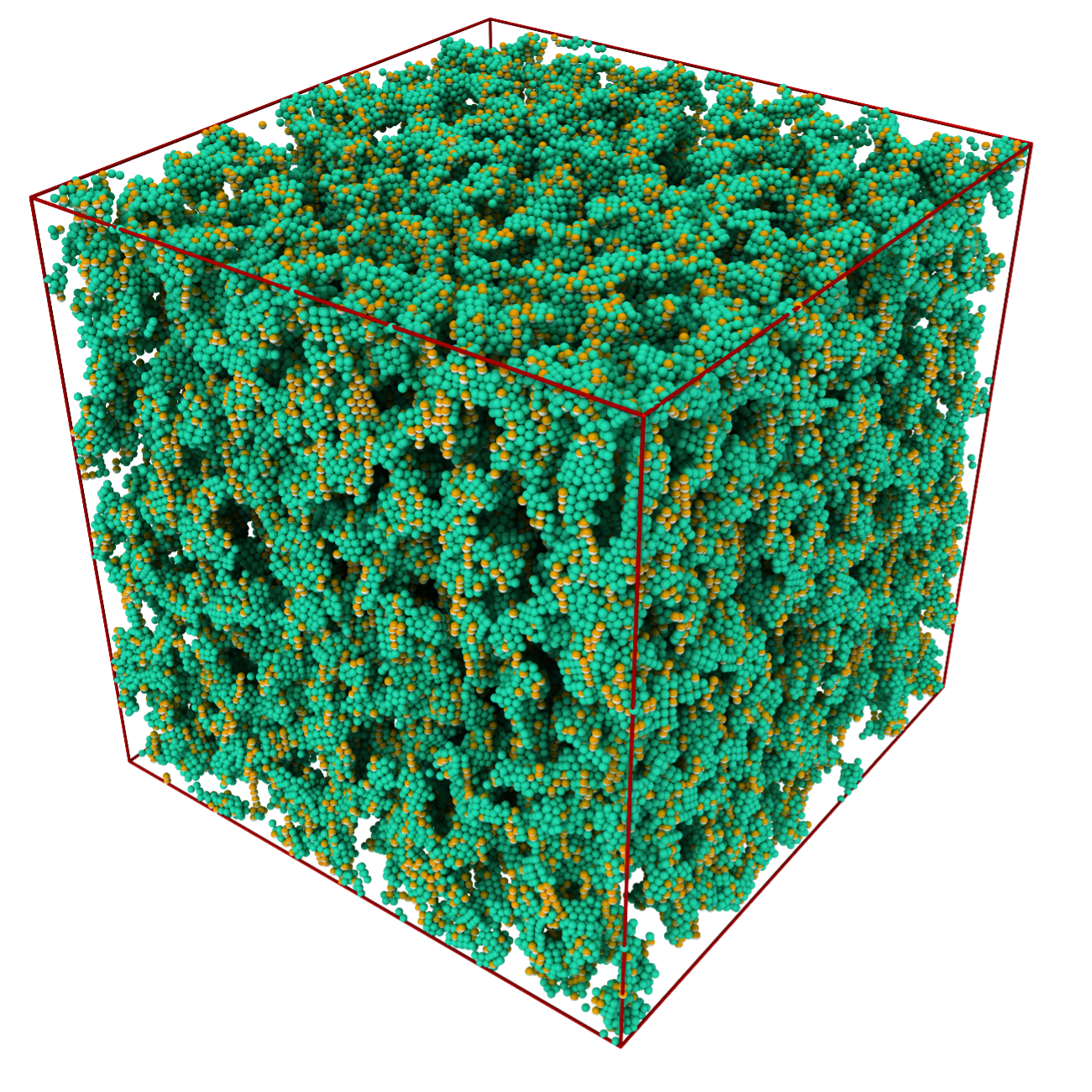
General Description: Anisotropic cell matrices have been shown to be suitable for culturing anisotropic cells, allowing control over the shape and mechanical properties of the resulting tissue. In this context, magnetic gels are promising cell matrices because their shape can be readily controlled by an external magnetic field. The external field aligns the magnetic dipoles, promoting their self-assembly into chain-like structures oriented along the field and thereby yielding an anisotropic material. In this work, we investigate the transition from an isotropic to an anisotropic state using Brownian Dynamics simulations with hydrodynamic interactions of colloidal gels composed of magnetic particles, spanning a wide range of attraction strengths and field intensities. We focus on the dynamics of the magnetic particles, computing several parameters that characterize their behavior. The degree of anisotropy is quantified using the static structure factor. We simulate 216,000 particles to obtain results with high scattering resolution.
Relevance: An important challenge in tissue engineering is to recreate the microenvironment required for cell culture. This often demands precise control of temperature and humidity, as well as of the external stresses imposed on cells, which strongly influence their mechanical properties and growth rates. In addition, the differentiation of anisotropic cell types (e.g., osteocytes) from stem cells requires an anisotropic matrix. Thus, controlling the degree of anisotropy provides a means to modulate not only the external stress but also the final morphology of the cultured cells. Magnetic gels are a promising route to improving the quality of laboratory-grown tissues because their anisotropy can be finely tuned by adjusting the external field. Therefore, understanding the mechanisms that determine the final degree of anisotropy enables the rational design of magnetic gels with properties tailored to specific applications.
What will be done: We will simulate 216,000 colloidal particles, a subset of which carry a magnetic moment. We include long-range hydrodynamic interactions, which have been shown to play a crucial role in the dynamics of colloidal gels. Our focus is the relationship between clustering of magnetic particles and the degree of anisotropy. Clustering will be quantified using dynamical metrics such as the mean cluster size and the cluster-size distribution, whereas anisotropy will be characterized by the static structure factor. Because particles within gel strands exhibit glassy behavior, we expect clustering to be driven primarily by the attachment of small clusters to larger structures. A key process in this regime is the breakage of bonds between non-magnetic particles, which we expect to dominate the clustering dynamics.