

Anchoring Behavior in Colloid-Stabilized Liquid Crystals Droplet
By: Lira Elías
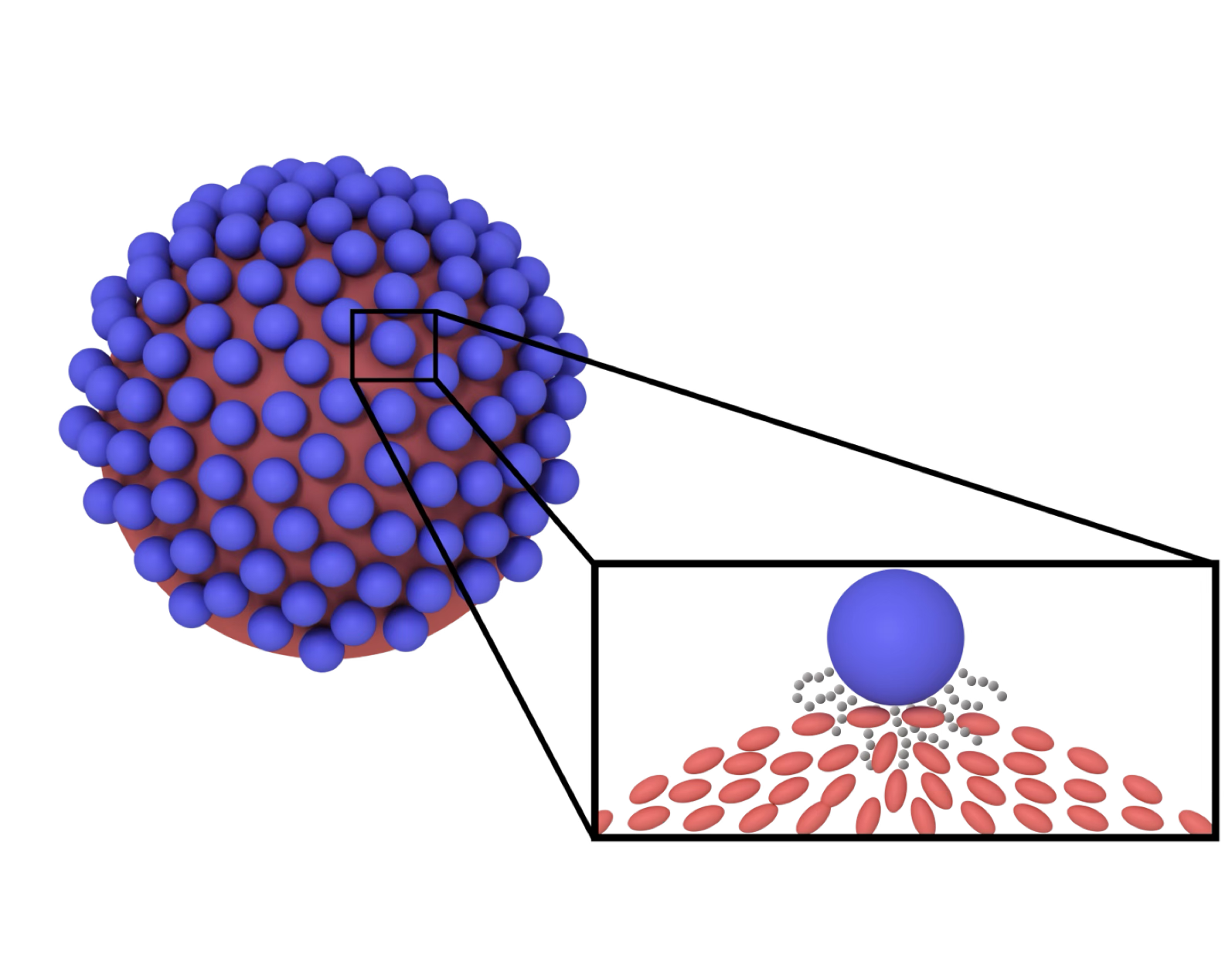
General description: This work aims to elucidate the design parameters of surfactant-functionalized nanoparticles that govern anchoring at the LC–water interface in nematic droplets, and to quantify their impact on structural transitions (including from the bipolar configuration), anchoring type, interfacial energy, and contact angle.
The relevance or importance of the work: Pickering strategies can markedly enhance emulsion stability; understanding the key surfactant functionalized nanoparticle properties that control anchoring at nematic LC–water interfaces can provide quantitative insights linking surfactant-functionalized nanoparticle characteristics to interfacial energy, contact angle, structural configurations, and rheology. These insights can guide rational colloid design toward longer-lived, tunable, and stimuli-addressable LC emulsions for reconfigurable optics, sensing, and controlled delivery.
What will be done: Develop a numerical simulation study using a coarse-grained dissipative particle dynamics (DPD) model in LAMMPS of a nematic LC droplet stabilized by surfactant-functionalized nanoparticles; map anchoring regimes and structural transitions, and identify key design trade-offs.