

Student Spotlight: Salomón Horna-Shirola
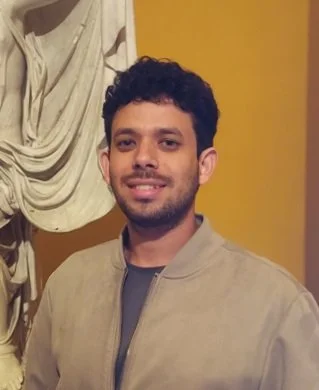
Salomón Horna-Shirola
M.S. Candidate, Mechanical Engineering
At the heart of transformative scientific discoveries are curious minds driven by a passion to understand the world and contribute to society’s progress. Salomon Horna-Shirola, a third-year Master’s student in Mechanical Engineering originally from Peru, embodies this spirit through his cutting-edge research on magnetic colloidal gels at the University of Puerto Rico Mayagüez (UPRM).
Salomon’s journey to UPRM began during his undergraduate studies when he connected with Dr. Ubaldo M. Córdova’s research group and became inspired by their groundbreaking work in soft materials. “Many international students have been impacted by the efforts of this group, gaining the opportunity to contribute to society through the research conducted here,” he shares.
Under the guidance of Dr. Córdova and as part of the Theoretical Soft Matter & Fluid Mechanics Research Group, Salomon’s research focuses on colloidal gels with magnetic particles. Salomon describes his research in accessible terms: “I’m working on colloidal gels with magnetic particles. Colloidal gels are a type of soft material composed of micron-sized particles. The presence of magnetic particles allows their properties to be controlled using magnetic fields. I’m studying the complex dynamics between colloidal and magnetic particles through numerical simulations.” By employing sophisticated computational models, Salomon is able to simulate the interactions within these gels—interactions that are otherwise extremely challenging to observe experimentally.
Connecting Research to Real-World Change
One key scientific challenge his research tackles is understanding how magnetic particles alter the gel’s microstructure. “The importance of this work to the field of magnetic gels lies in the fact that we are addressing a key open question: how the gel microstructure is affected by the presence of magnetic particles,” Salomon explains.
This research goes beyond theory with promising applications in cancer treatment and advanced biomedical technologies. “Advancing the understanding of magnetic gels offers the possibility of overcoming the current limitations faced in this field, especially those related to the fine control of the gel network,” he says. His simulations have revealed how hydrodynamic interactions—fluid forces at the microscale—play a crucial role in restructuring these gels, a finding Salomon is especially proud of: “In this work, it has been demonstrated that hydrodynamics plays a crucial role in gel restructuring. I’m especially proud of this finding, as incorporating the hydrodynamic model into the simulation framework was very challenging.”
To carry out this complex work, Salomon relies on the advanced computing power of UPRM’s HPC Voyager supercomputer. This high-performance cluster, composed of multiple nodes with powerful processors and GPU acceleration, allows him to run intricate simulations and process vast data efficiently.
Growth Through Challenge and Discovery
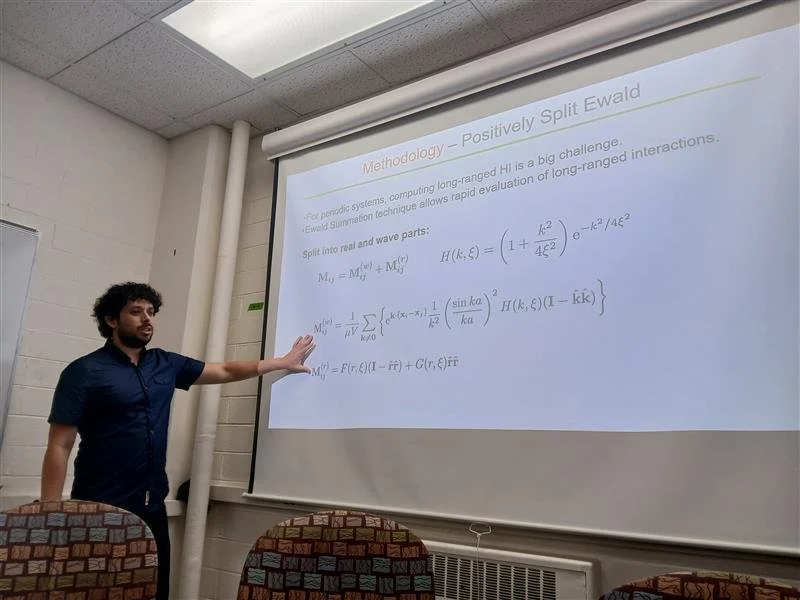
Salomon’s role encompasses the entire research process, from coding simulations and data analysis to preparing scientific publications. This hands-on experience is cultivating not only his technical skills in programming and scientific communication but also valuable personal qualities: “From a personal point of view, this research has taught me that perseverance is the key to success.”
Looking ahead, Salomon plans to expand his research by exploring Janus particles, analyzing how magnetic gels behave under shear flow, and investigating the magnetorheological effect. Ultimately, he hopes his findings “could be combined with experimental studies for developing new soft materials for biomedical applications.”
For Salomon, research is not just about solving technical challenges—it’s about contributing to the greater good. “I’ve always been curious about how the fundamental laws shape the world. Research is important to me because it’s the way I engage with the goal of discovering how things work. Additionally, research enables society to find new ways to address emerging challenges. The feeling that I’m contributing to building a better community keeps me motivated to continue doing research.”
Despite the complexities and challenges, Salomon finds deep fulfillment in the research process: “There were many times when I felt there was no solution to the problems that had arisen. However, I remained persistent, which eventually led to overcoming those challenges. The feeling of having your hard work rewarded is priceless.” His advice to other aspiring researchers underscores the importance of foundational knowledge and patience: “In my opinion, the most important skill a beginner should acquire is building a strong foundation of knowledge. Of course, it takes time, but it will be rewarded in the future.”