

Student Spotlight: Jonathan A. Victoria-Camacho

Jonathan A. Victoria-Camacho
Ph.D. Candidate in Bioengineering, UPRM
For Jonathan A. Victoria-Camacho, science begins at the particle level—but its reach extends far beyond the microscope.
Now in his sixth year of doctoral studies at the University of Puerto Rico - Mayagüez (UPRM), Jonathan is investigating how tiny magnetic particles self-assemble into intricate structures. It’s a line of research that blends physics, engineering, and imagination, with powerful implications for smart materials, micro-robotics, and biomedical devices.
“I was drawn to this field by the beauty of soft matter systems and the possibility of combining theory, simulation, and physics.” he explains “It fascinates me how particles at such a small scale can exhibit collective behavior and self-organization that resembles living systems. This blend of simplicity and complexity continues to inspire me.”
Jonathan’s research is deeply personal—it lives at the intersection of theory, simulation, and biomedical applications, which he sees as core to his identity as a bioengineer. Studying magnetic Janus particles allows him to uncover how microscale systems behave and organize in complex environments, knowledge that is critical for developing next-generation biomaterials and medical devices.
“What motivates me is the potential for real-world impact,” he says. “From magnetically guided drug delivery systems to adaptive structural components in wearable devices, the insights from this research can help shape smarter, more responsive biomedical technologies.”
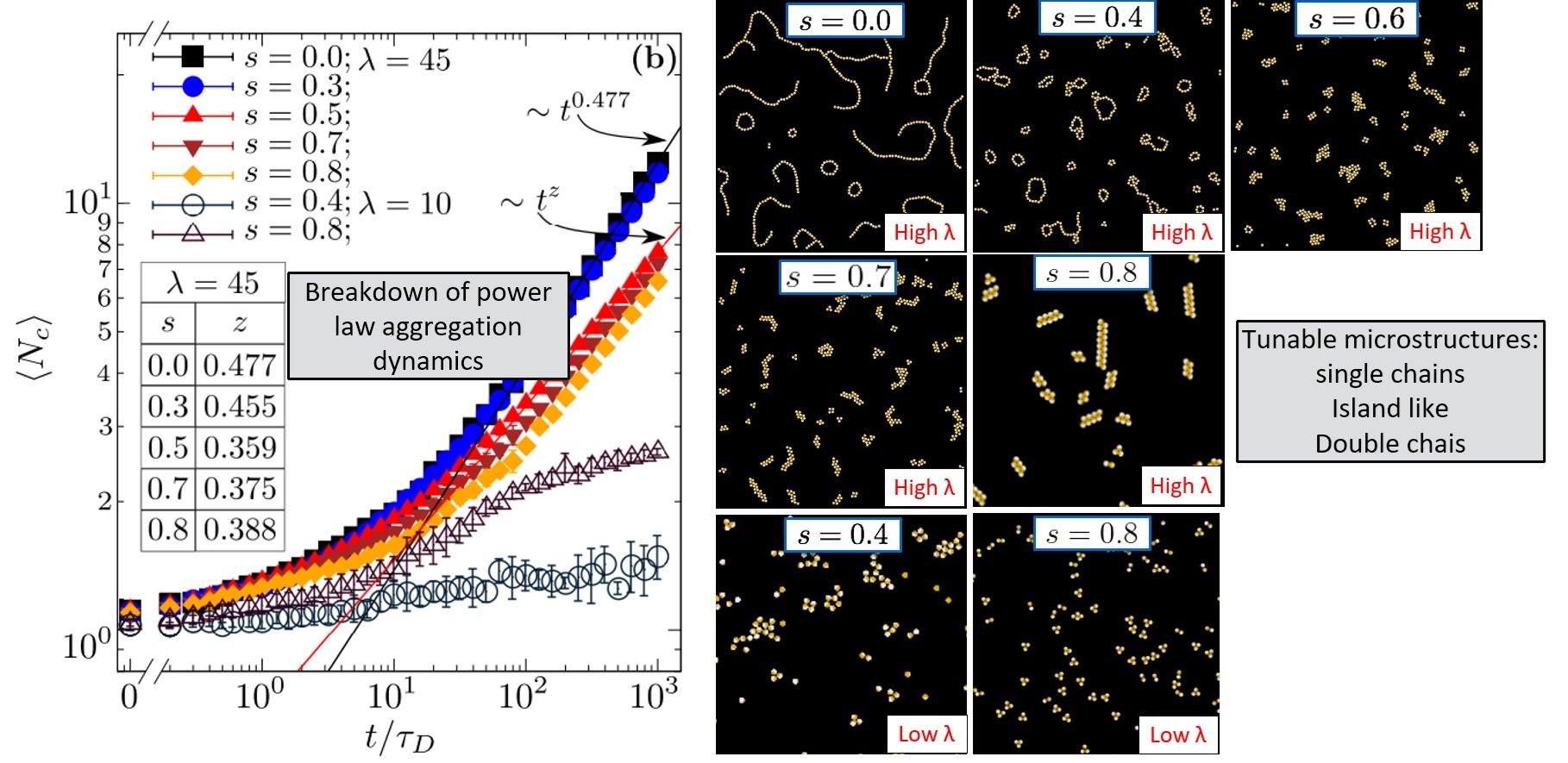
Under the mentorship of Dr. Ubaldo M. Córdova-Figueroa in the Theoretical Soft Matter & Fluid Mechanics Research Group, Jonathan uses Brownian dynamics simulations to study magnetic Janus colloids—microparticles with one magnetic and one non-magnetic hemisphere. By adjusting properties like magnetic dipole orientation and self-propulsion, he investigates how these particles move, interact, and ultimately self-organize.
Pushing the Boundaries of Materials Design
Jonathan’s work explores the fundamentals of active matter—materials that move and organize on their own, often in response to external forces like magnetic fields. These insights can have impact in areas such as smart materials, microrobotics, and biomedical systems.
“This field has potential across many domains,” he says. “For example, the ability to design self-assembling systems at the micro- and nanoscale can lead to materials and devices that respond to magnetic fields or environmental changes with precision and adaptability.”
Jonathan is already making an impact in the field. His 2020 publication in Soft Matter, titled “Self-assembly of magnetic colloids with radially shifted dipoles”, marked a key milestone in his Ph.D. journey. He also earned third place for a poster presentation at the ACS Colloid & Surface Science Symposium in 2018 and has presented his research at numerous international conferences and symposia.
A Passion for Discovery and Collaboration
Though his work is grounded in computation, Jonathan emphasizes the importance of collaboration. He has worked closely with students and faculty across departments and institutions, including a fruitful partnership with the lab of Prof. Ilona Kretzschmar at The City College of New York (CUNY). These collaborations have enriched his understanding of both simulation and experiment.
“These collaborations have provided me with valuable insights and complementary experimental perspectives.” he says.
To power his simulations, Jonathan relies on the high-performance computing infrastructure at UPRM—including in-house servers and the Voyager cluster—as well as computational resources at CUNY. The Voyager cluster consists of a series of computer nodes, each with multiple processors, large memory, and even GPU acceleration that allows to run complex simulations and process large amounts of data quickly and efficiently. For visualization, he uses tools like Ovito Pro to analyze particle motion and structure in 3D.
Shaping the Future of Bioengineering
As he nears the completion of his Ph.D., Jonathan is preparing to defend his dissertation and publish additional findings. But the work won’t end there.
“I hope my research contributes to the broader understanding of active and magnetic colloidal systems and helps lay the groundwork for new programmable materials and self-assembling devices.” he says. “Long-term, I aim for this research to support innovation in both fundamental science and real-world technologies.”
He’s also deeply committed to mentorship and education, regularly guiding younger students in simulation techniques and sharing insights into soft matter physics. “One of the most rewarding parts of this journey has been sharing my knowledge—whether through mentoring, writing, or presentations…”
Advice for Aspiring Researchers
Jonathan encourages other students to explore research early and often.
“Be curious and proactive. Ask questions. Try new tools. Reach out to people whose work inspires you,” he says. “Research is a journey where collaboration and persistence matter just as much as knowledge. The earlier you get involved, the more opportunities you’ll have to grow.”