

Student Spotlight: Jeferson Cesar Urtecho-Espinoza

Jeferson C. Urtecho Espinoza
M.S. Candidate, Mechanical Engineering
At the University of Puerto Rico, students are leading innovative research that have the potential to address urgent global challenges. For Jeferson Cesar Urtecho-Espinoza, a second-year master’s student in Mechanical Engineering from Peru, this means tackling the environmental threat of Per- and polyfluoroalkyl substances (PFAS)—often called “forever chemicals.” PFAS are man-made compounds used in products such as firefighting foams, non-stick cookware, and water-repellent fabrics. Because of their strong chemical bonds, PFAS do not break down easily and can persist in the environment for decades. Today, they are found in the blood of 97% of Americans and in drinking water for more than 200 million people. Even at very low concentrations, exposure has been linked to cancer, thyroid disease, and developmental issues. Jeferson’s work aims to improve how scientists detect and remove these pollutants, protecting communities and advancing environmental sustainability. His work aims to improve how scientists detect and remove these pollutants, protecting communities and advancing environmental sustainability.
From Curiosity to Research Purpose
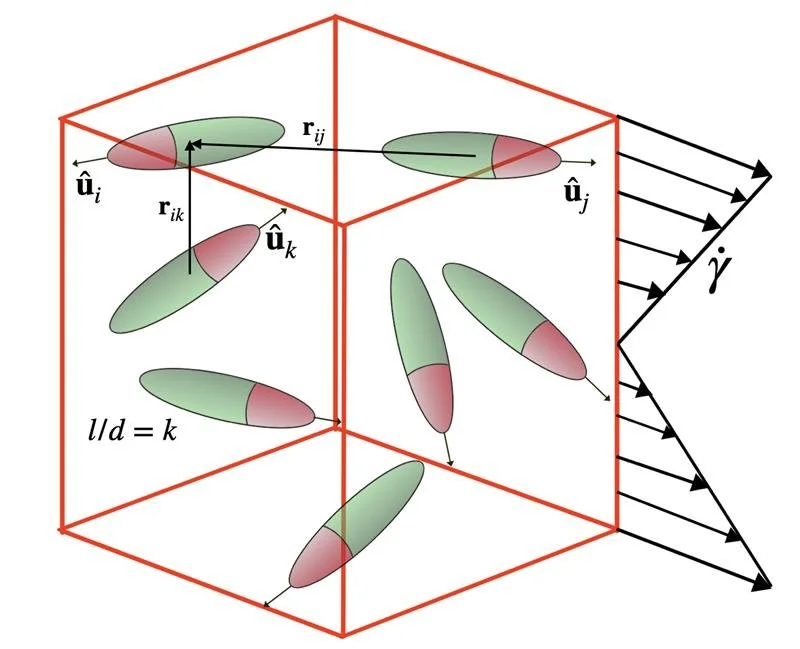
Working under the guidance of Dr. Ubaldo Cordova Figueroa in the Theoretical Soft Matter & Fluid Mechanics Research Group, Jeferson uses computational simulations to study PFAS. “My research focuses on studying the physical properties and self-assembly of environmental surfactant contaminants known as PFAS, by modeling them as ellipsoidal particles and using computational tools,” he explains.
The motivation behind his project is deeply personal and driven by environmental concerns. “The environmental concern about the harmful effects of compounds like PFAS surfactants on natural ecosystems motivated me, especially considering that reducing their concentrations in the environment poses a significant challenge for regulatory agencies. For this reason, I decided to contribute to the understanding of the behavior of these compounds through the use of programming, physics, and mathematics tools.”
Innovating with Computational Tools
Jeferson plays a central role in developing and running simulations. “I am in charge of studying the rheology and self-assembly of PFAS modeled as ellipsoids, using a Brownian Dynamics approach, which incorporates a random term for the translation and rotation of the particles under study.”
This unique approach stands out in the field. “In the field of PFAS compound research, this work is crucial as it introduces a new analytical paradigm through ellipsoidal modeling. To date, most studies have focused primarily on the molecular description of PFAS. Furthermore, the application of the Brownian Dynamics approach in Molecular Dynamics studies is essential for obtaining accurate data on the macroscopic behavior of solutions containing PFAS compounds.”
Building Solutions with Real-World Impact
The implications of this research extend well beyond the lab. “The data obtained from this research can help improve the process of removing these contaminants from the environment. It can also be used to calibrate data from electrical or chemical devices that detect properties such as concentration, thereby enabling the identification of PFAS in environments like soil or drinking water.”
This type of work is essential because PFAS contamination is so widespread, and current solutions for detection and remediation remain costly and complex. By providing a more accurate model of how PFAS compounds behave, Jeferson’s findings could pave the way for more effective and efficient technologies to protect communities.
Growth Beyond the Classroom
Through his research, Jeferson has gained technical expertise and personal growth. “I have significantly improved my proficiency in the programming languages Python and C++. Additionally, I have applied numerical analysis theory to implement particle behavior using these computational tools. This process has not only enhanced my skills in preparing presentations and writing reports but has also supported my learning of the English language.”
The experience has also shaped his career direction. “This work has significantly enhanced my ability to deeply understand concepts in materials science, as well as to use computational tools for analyzing particle structure data. It has also improved my ability to communicate research ideas in an academic context and to grasp the underlying mathematics of the process. Overall, it has clarified my vision and strengthened my desire to continue conducting research in the field of soft matter and materials science.”
The Road Ahead
Jeferson is excited to continue advancing the project. “The next steps in the project include addressing some issues with the custom implementation of the Gay-Berne potential, which prevents particle overlapping. After that, the goal is to implement the electrostatic polar potential to simulate the micelle formation behavior—structures typically formed by PFAS compounds. Additionally, the plan includes increasing the concentrations to favorable levels for micelle formation and eventually introducing a shear flow to study the system’s rheology.”
Rewarding Milestones
One of the most meaningful parts of Jeferson’s journey has been seeing his work take shape. “It has been rewarding to implement the system and visualize the simulation using the Ovito software—seeing that the mathematics used works for the motion of the ellipsoidal particles. Throughout the process, I have also been able to identify errors and make improvements to the work being done with the system.”
Words of Advice for Aspiring Researchers
For students considering research, Jeferson offers thoughtful guidance:
“My advice would be not to be afraid of areas of knowledge you may not be familiar with when starting research. You learn throughout the process, and encountering mistakes to correct is also part of the learning experience. It helps improve your understanding of the work you’re doing as a researcher and contributes to generating knowledge that can be used by other researchers to solve problems in various fields.”
Through dedication and innovation, Jeferson is advancing scientific understanding of PFAS contaminants while preparing for a future in soft matter and materials science. His research reflects the University of Puerto Rico’s commitment to addressing global challenges—and demonstrates the powerful impact of student discovery supported by faculty mentorship and external funding.