

How Can AI Help Us in Science?
Artificial Intelligence (AI) has moved beyond science fiction to become one of today’s most transformative forces in scientific discovery. Across disciplines—from biology to engineering—AI is revolutionizing the way research is conducted, data is analyzed, and innovative solutions are developed. At our research group, we’re harnessing AI to fast-track breakthroughs in soft materials and fluid dynamics, pushing the boundaries of what’s possible in material science.

AI has been used in science for decades, but only recently has it matured into a sophisticated tool capable of learning, predicting, and automating complex tasks. Early uses of AI focused on basic data analysis and simulations, but today’s AI helps us predict protein structures, refine experimental design, detect patterns in enormous datasets and drive autonomous lab systems.
This shift means scientists can now tackle problems that were previously too large, too complex, or too time-consuming.
Our group focuses on studying soft matter—like colloids, fluids, and nanoparticles—and their dynamic behavior at microscopic scales. These systems are incredibly intricate and generate massive amounts of data, making them ideal for AI-assisted analysis. Our team uses it for data interpretation, behavior prediction, and experiment optimization.
With AI, our team can design smarter experiments, reduce trial-and-error, and discover hidden behaviors in soft matter systems.
Incorporating AI into our work has already led to major improvements in research efficiency and discovery. Some notable outcomes include a faster design of custom colloids, the identification of unexpected interactions in particle systems that open new research directions, and a dramatic reduction in simulation analysis time—from weeks to just hours—accelerating publication and innovation timelines.
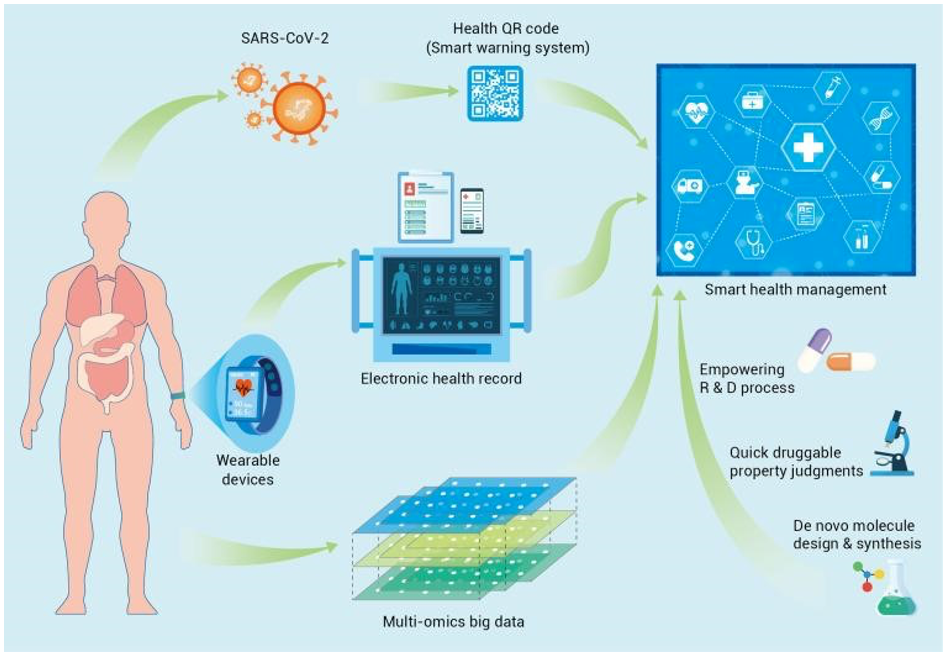
Source: Artificial intelligence: A powerful paradigm for scientific research Article at sciencedirect.com
Integrating AI into scientific research has required our team to take an active, hands-on approach. Since AI is still an emerging tool in soft matter research, existing code often needs to be adapted to meet the unique demands of their work. With most of our members coming from mechanical engineering backgrounds, they have embraced new learning opportunities—taking additional courses in AI, programming, and data science—to effectively incorporate these technologies into their research. This proactive mindset reflects their commitment to innovation and their ability to combine engineering expertise with advanced computational tools to break new ground in scientific discovery.
These discoveries go far beyond the academic—they hold transformative potential for industry. AI-driven materials research is opening new frontiers across key sectors:
Advanced manufacturing: Developing materials that are stronger, lighter, and more adaptable.
Biomedical engineering: Creating particles for precision drug delivery and next-generation diagnostics.
Energy and sustainability: Enhancing catalysts, batteries, and energy storage systems for a cleaner future.
As this field evolves, its integration into science and engineering will define the next wave of industrial innovation. Our team at the Theoretical Soft Matter & Fluid Mechanics Lab is at the forefront, pushing the limits of what’s possible when AI meets materials science.
But breakthroughs like these don’t happen in isolation—they require vision, collaboration, and support.
Join us. Partner with innovation. Help shape the future.