

Member Spotlight: Ajay Vallabh on Tracking Forever Chemicals from the Molecular Scale Up
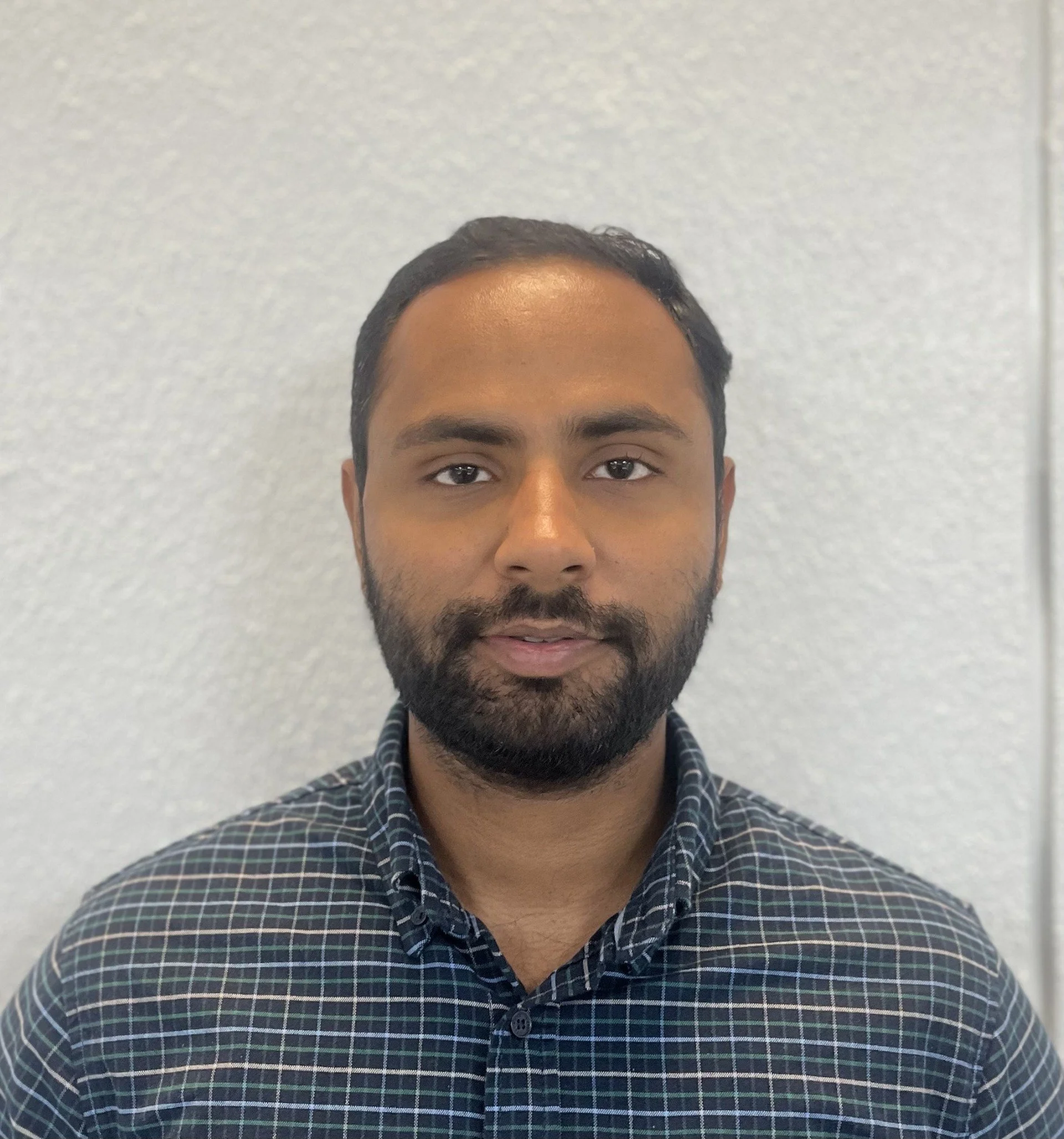
Ajay Vallabh arrived in Mayagüez by way of Agra, Kanpur, and New Hampshire. His path through mechanical engineering has taken him from the classical fluid mechanics of his undergraduate training at GLA University in India to molecular-scale simulation of environmental contaminants at the University of Puerto Rico at Mayagüez (UPRM), where he now works as a SERDP postdoctoral fellow in the Córdova-Figueroa Research Group. Along the way, he earned a master’s degree in fluid and thermal science at the Indian Institute of Technology Kanpur and a PhD at the University of New Hampshire, building expertise in polymer mechanics and material modeling that now serves a very different kind of problem.
That problem is PFAS. Per- and polyfluoroalkyl substances, often called “forever chemicals,” resist degradation because of their extraordinarily strong carbon-fluorine bonds. They persist in water, soil, and biological systems, and understanding how they move through these environments is a central challenge in environmental science. Ajay’s research sits at the intersection of molecular dynamics simulation and machine learning, and his goal is direct: build predictive tools that can tell us where PFAS go and why.
“I am passionate toward cutting-edge research in soft-matter and wanted to explore hands on education approach. I believe that building any new skill requires a strong foundation, and that inspired me to continue my studies in mechanical engineering with a specialization in polymer mechanics and material modeling.”
Simulating PFAS, one molecule at a time
PFAS molecules do not behave like simple dissolved ions. In solution, they self-assemble into structures: micelles, bilayers, vesicles. The geometry of these aggregates determines how PFAS interact with surfaces and how they migrate through porous media, sediment, and biological membranes. Predicting which structure forms under which conditions requires resolving molecular-scale forces over meaningful timescales.
Ajay uses molecular dynamics (MD) simulations to model these processes. In an MD simulation, every atom in the system obeys Newton’s equations of motion, and the simulation tracks how thousands of molecules rearrange over nanoseconds to microseconds. For PFAS, the relevant physics includes hydrophobic and electrostatic interactions, the rigidity of the fluorocarbon backbone, and the energetics of aggregation.
“In simple terms, my research aims to better predict the movement and interaction of PFAS in the environment, which can help support future efforts in pollution control and cleanup.”But simulation alone is not enough. The chemical diversity of the PFAS family is enormous: thousands of structurally distinct compounds exist, and running a full MD simulation for each one is computationally prohibitive. So Ajay couples his simulations with machine learning methods, including XGBoost, Transformers, and Graph Attention Networks, to predict how PFAS adsorb to or desorb from surfaces of different polarity and how they partition between phases. The machine learning models learn from the simulation data, then generalize to compounds and conditions that have not been simulated directly.
“One of the most exciting milestones in my research has been building a bridge between molecular-level simulations and machine learning to better understand PFAS behavior... Seeing how these structures affect their movement and interaction with surfaces (polar, non-polar, neutral) has been very exciting for me, because it gives us a more fundamental understanding of why PFAS behave differently in different environments.”
The combination matters. PFAS contamination is not an abstract scientific question. These chemicals are found in drinking water, firefighting foam residues, and industrial discharge sites around the world. Predictive models that work across the PFAS family could accelerate screening, prioritize remediation, and guide the design of filtration systems.
Growth through structure
Ajay describes his transition into the research group as a process of becoming more organized and more deliberate.
“Being part of the UCF Colloids Research Group has helped me become a more organized and structured researcher. The group meetings and discussions have strengthened my critical thinking and often helped me generate new research ideas.”
The group’s biweekly progress reports, he says, have taught him accountability. Journal club meetings have broadened his reading beyond his core simulation work. And the winter and summer workshops, along with industrial networking events, have created opportunities for collaboration that extend well beyond campus.
“I also feel very fortunate to work under Dr. Ubaldo’s mentorship, because he is consistently supportive, inspiring, and encouraging in both research and professional development.”
His daily routine reflects that discipline. Ajay starts early, usually by 8:00 AM, and structures his days around specific simulation and analysis goals. He credits the group’s diverse, collaborative environment for keeping the work both productive and enjoyable.
Beyond the lab
Outside research, Ajay maintains a full life. He begins each morning with Tai Chi and yoga around 6:00 AM, follows it with gym workouts in the evening, and is currently learning salsa dancing. On weekends, he visits the beach with friends, cooks Indian food, attends community gatherings, and goes to church on Sundays.
“Research is not only about academics, it is also about personal growth, resilience, and learning from the people around you.”
Looking ahead
Ajay sees his next step as a move into academia, where he can combine teaching and research.
“After completing my current program, I see myself pursuing a role as an instructor or assistant professor, where I can combine teaching, mentoring, and research. I would like to work closely with undergraduate and graduate students, guide them in cutting-edge research projects, and help them grow academically and professionally.”
His advice to students considering a research career is characteristically practical: come in with an open mind, stay patient and organized, learn from those who have walked the path before you, and enjoy the process. Growth, he says, comes step by step.
Join the conversation
The Córdova-Figueroa Research Group at UPRM studies problems in soft matter, colloidal physics, and transport phenomena. We are always looking for motivated students and collaborators who share our curiosity about the physical world at small scales. If Ajay’s story resonates with you, visit ucfcolloids.org to learn more about our work, or reach out to explore opportunities in the group.